Sheet 02
The national road
The city is still in the mirror when the ring straightens. By late afternoon the cab smells of hot dust and wet stone, and you have stopped once for a coffee whose name you will not keep.
Leaving the built edge
The first minutes are signals, worn lanes, and a truck filling the right-hand glass. Then the ring opens into a wide arc past depots, with signs for towns you will not enter today.
The first village comes after a low bridge, with no large announcement. Houses sit close to the asphalt, and a person with a shopping bag crosses without hurrying.
The vignette you already know
On the main roads a vignette is simply part of driving, the way washer fluid is. The driver already knows it is there, either as a sticker in the corner of the glass or as an electronic note tied to the plate.
It is not a stop, and it is not a place to see. It stays with the car while you use those roads, and you forget it until the next morning you leave a city.
Valley, then the pass
In the valley you hold one gear and let the river show the line. Poplars stand in a row, and their shade stripes the bonnet.
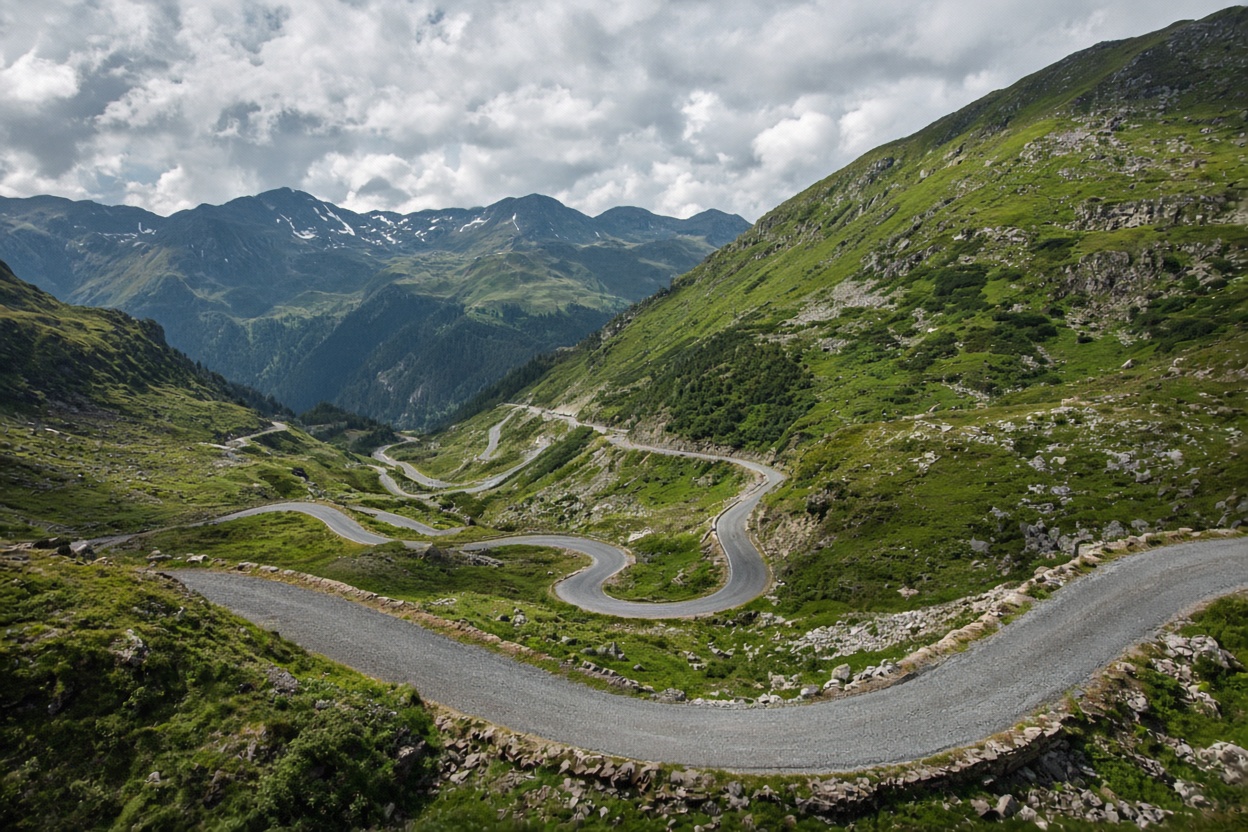
On the pass the same road changes gradient. The switchback drops you into second, a truck ahead, the stone wall a hand width from the mirror.
Where people stop for coffee
Coffee happens where there is shade and a kettle, not where one name is hung across ten counties. The cup is thick, and the sugar sits in a jar with a metal lid.
Two trucks idle in the parking gravel. The dog by the counter stays down, and ten minutes is enough before you turn the key again.
Night, summer, winter
After dark you drive inside the headlight slice, and the reflective studs on trailers are the only sure points. An overtake waits until the lane ahead is empty for as far as you can read it.
In summer the plain shimmers and the side glass heats the cabin. In winter the shaded hairpin keeps a crust, and the gap between cars opens on its own.