Sheet 05
The delta
Toward the delta the national road runs straight over the plain, poplars on one side and grain trucks on the other. At Tulcea the asphalt runs out of reasons, and from there you travel by channel.
The plain before it
The last stretch is wide and flat, with a midday shimmer over the tarmac. Villages are few, and the stops have a bench and a dog in the shade.
The Danube announces itself in the air before you trust a sign. The smell changes, and reeds show in the ditch before you see the wide water.
Tulcea
Tulcea is the threshold. You park by the bank, and the car stays there like an object from another kind of trip.
People carry cans, rope, and a toolbox down toward the boats. Talk on the bank is about the channel, the wind, and the depth, not about the overtaking lane.
The channel
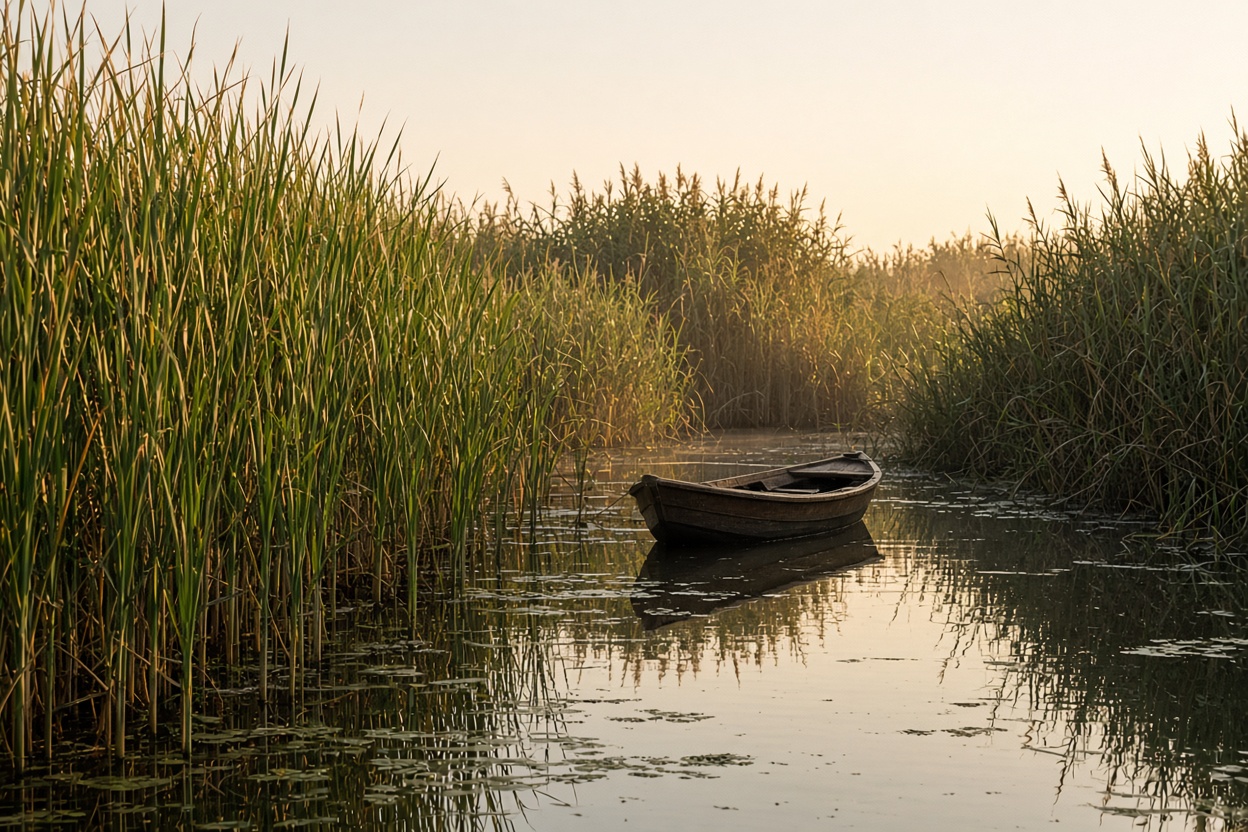
A wooden boat enters a narrow channel, reeds on both sides and higher than your head. The small engine holds one note, and the water is dark green in the shade.
The hard shoulder disappears, and a gap in the reeds remains beside a willow. The road, as an idea, stops where someone tied up an older boat.
The light
The light lies flat, on the water and on the reed heads. A fisher sits still, and you ease the engine so you do not break that patch of mirror.
By evening the mosquitoes write the day more clearly than any sign. You come back to the bank with dried water on your sleeves and the car exactly where you left it, still warm on the metal.
Back on the asphalt
The next day you get into the car and the road feels narrow, though it is the same road. After an hour on the water, the painted lanes look like a drawing.
The notebook keeps the channel, the boat, and the fact that the road knew how to stop. Not every edge of the country ends in a roundabout.