Sheet 04
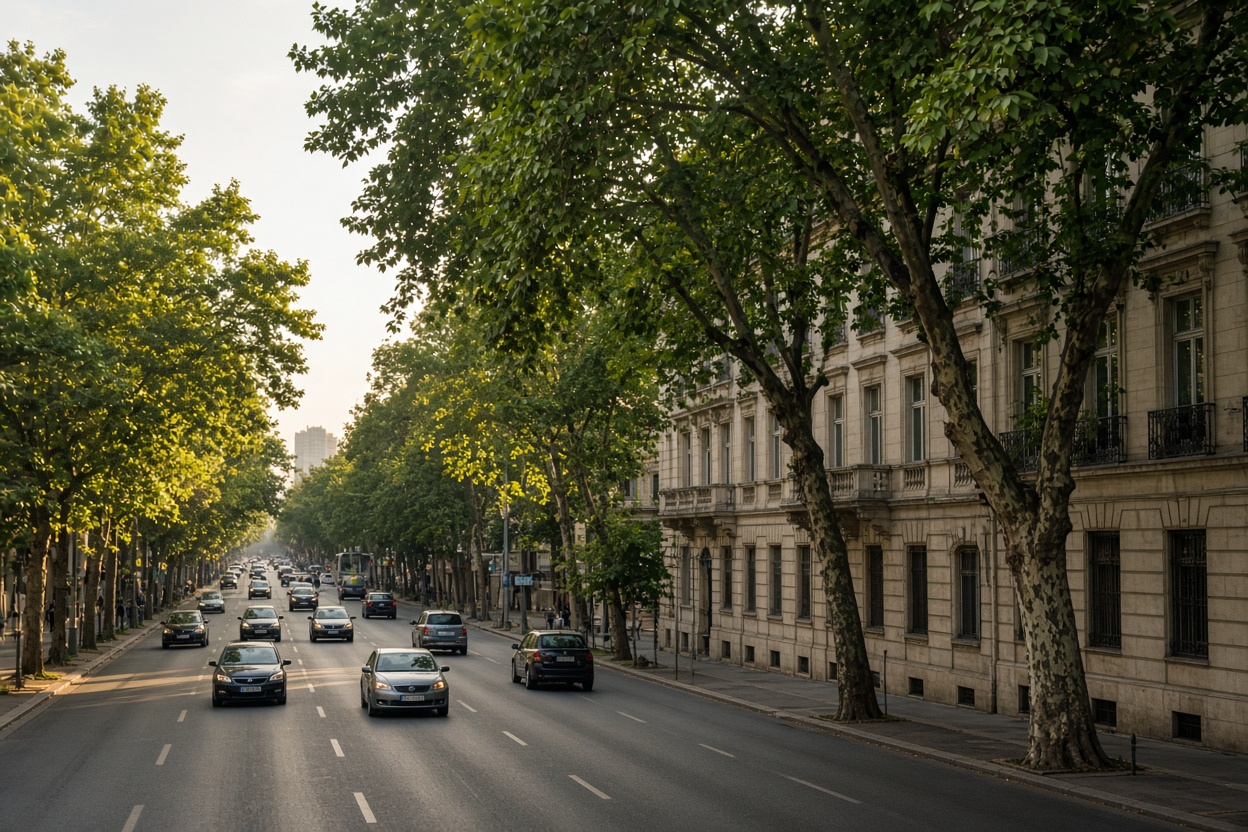
Bucharest
In this notebook the capital is not where you set off. It is where a national road gets tired and turns into a boulevard, trees cut level above the roofs of cars.
On the boulevard
Past the ring, the lanes multiply and the signs crowd together. A wide boulevard takes you between aligned trees, and the tram holds the middle like a second road.
Blocks stand back from the kerb, then houses appear with a vine on the gatepost. The city has more than one edge, and you cross several of them without a clear announcement.
Stopping
A parking space is a small win, between two poplars or in a yard where someone has left a ladder. The engine ticks, and you hear the city only after the key is off.
On foot the boulevard is longer than it looked from the driver seat. People wait at the crossing, and a delivery truck blocks a lane without hurry.
Evening
At dusk the headlights mix with shop glass and with signals that keep their own tempo. The tarmac still holds the heat of the day, and the air smells of dust and of linden when the trees are in flower.
You do not look for a centre in order to close the day. You look for a table, water, and a side street where the car fits without sticking out past the kerb.
Leaving at first light
Getting out of Bucharest starts before full daylight, when the boulevard is nearly empty and the trams run their first loops. The ring is a wide loop again, with trucks that slept beside a fuel station.
In the mirror the city thins to a line of blocks. The notebook keeps the way the road arrived and then had to slow, not the museum rooms.
What remains
Seen from a car, Bucharest is trees, width, and a tiredness in the wrists. It is not a card you tick and drop.
The second time you enter, you recognise a fuel station and a bridge, not a facade. That is enough to know you are back where the roads gather.