Sheet 03
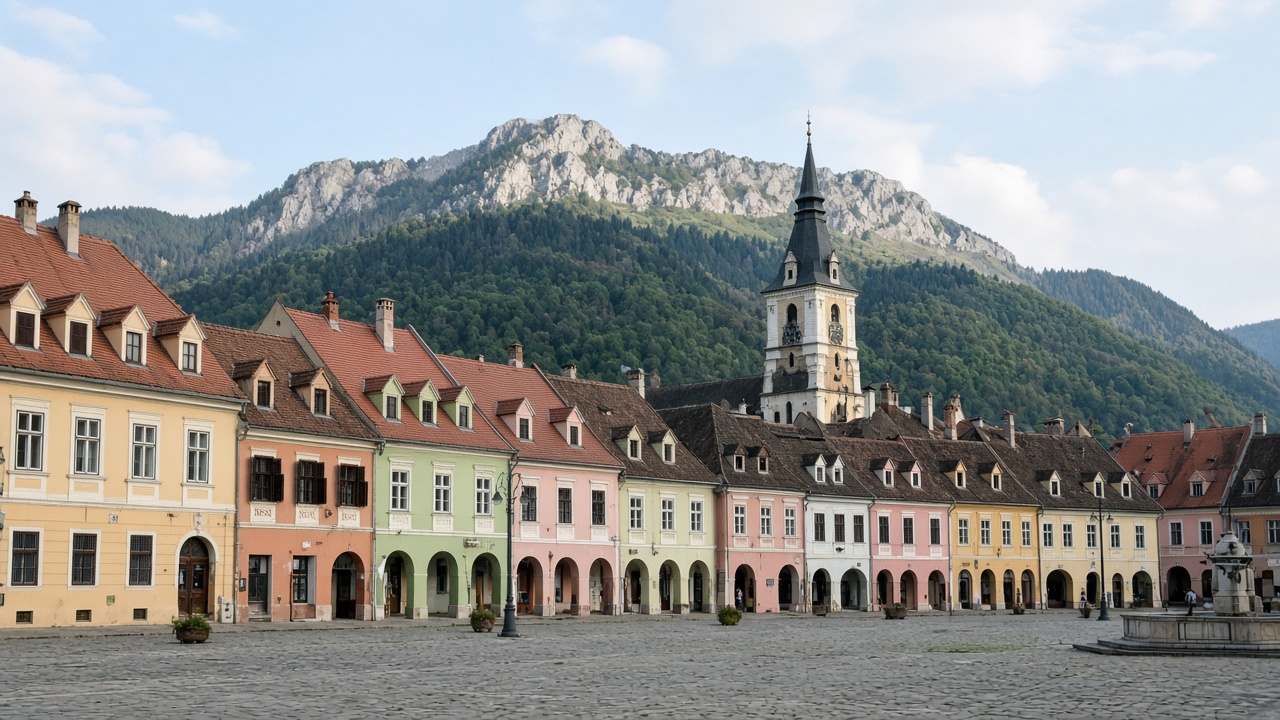
Brașov
You arrive when the road climbs and the town is suddenly there, the mountain immediately behind the square. You park, and the walk to the centre is shorter than the last half hour at the wheel suggested.
How the road climbs
From the valley the carriageway passes new houses and then older ones with timber on the upper floor. Traffic packs onto a street that knows everyone is trying to reach the square.
Once the car is left, the town is measured in steps. The square is flat, and Tâmpa stands vertical, close enough that cloud seems caught on the ridge.
The square
The square holds the afternoon light on its facades and loses it when the sun drops behind the mountain. Tables take the middle, and the stones under them are polished by shoes.
The tower over the old council house is the axle. You look for it when a side street has turned you around and the car could sit in any of three directions.
The morning after
Before the coaches, the square belongs to people carrying bread and to the crew washing the pavement. The air stays cold into July until the sun clears the ridge.
You will leave toward other mountain roads, but the night was here, with the window open a hand width. A bus climbs in short pulls of the engine and vanishes at the corner.
The mountain is not scenery
Tâmpa does not sit on a horizon. It closes one side of the town, and weather on the ridge reaches the square a few minutes later.
When rain starts up there, the stones below go dark before you feel a drop. Anyone who came over the pass knows this air, except that here the engine can stop.
The way out
The road out is national again, with fuel stations at the edge and a truck that spent the night on the exit lane. The town shuts in the mirror sooner than the climb on the way in.
Ten minutes on and you are between hills, and the square is an idea rather than a place. The notebook keeps the gradient, the tower, and the fact that the mountain stood behind the houses.